ASK Super-regenerative High-frequency Receiver Module
Model: RWS-371F (Series Models)
The RWS-371F series is a super-regenerative high-frequency receiver module using ASK modulation technology, featuring high sensitivity (-108dBm) and low power consumption. It is specifically developed for wireless alarm, remote control, and industrial automation applications. This series offers six different frequency versions, covering frequency bands from 303.875MHz to 433.92MHz, to meet regional regulatory requirements and diverse application scenarios.
The module adopts an LC oscillation circuit architecture, providing excellent frequency stability and anti-interference capabilities. The reception bandwidth reaches ±500KHz, supporting data transmission rates of up to 4.8Kbps. The wide operating voltage range (3.8-5.5V) design facilitates integration into various embedded systems and battery-powered applications. It requires minimal external components to achieve full RF reception functionality, significantly simplifying system design and reducing costs.
Product Core Features and Model Specifications
High Sensitivity Reception
Reception sensitivity up to -108dBm, ensuring stable long-distance communication
Multiple Frequency Options
Provides six frequency versions to adapt to different regional regulatory requirements
Low Power Consumption Design
Operating current is only 4.5mA, suitable for battery-powered applications
Fast Start-up
Receiver start-up time is less than 3ms, with quick response
Model
RWS-371F-1
RWS-371F-2
RWS-371F-3
RWS-371F-4
RWS-371F-5
RWS-371F-6
Frequency
303.875MHz
310MHz
315MHz
318MHz
418MHz
433.92MHz
Modulation Method
ASK
ASK
ASK
ASK
ASK
ASK
Sensitivity
-108dBm
-108dBm
-108dBm
-108dBm
-108dBm
-108dBm
Transmission Rate
4.8Kbps
4.8Kbps
4.8Kbps
4.8Kbps
4.8Kbps
4.8Kbps
Operating Voltage
3.8-5.5V
3.8-5.5V
3.8-5.5V
3.8-5.5V
3.8-5.5V
3.8-5.5V
Detailed Electrical Characteristic Specifications
Absolute Maximum Ratings
The electrical characteristics of the RWS-371F series modules have been rigorously tested and verified. The operating voltage range is 3.8V~5.5V (typical 5V), with data output high voltage up to Vcc-0.5V to Vcc, and low voltage below 0.3V. The typical operating current is only 4.5mA, making it ideal for low-power applications.
Symbol
Parameter
Test Conditions
Min
Typ
Max
Unit
Vcc
Operating Power Voltage
3.8
5
5.5
V
I Tot
Operating Current
4.5
mA
V Data
Data Output Voltage
Output High Level (1 Data = +200 uA)
Vcc -0.5
Vcc
V
V Data
Data Output Voltage
Output Low Level (1 Data = -10 uA)
0.3
V
RF Performance Parameters
The RF performance of each model is precisely calibrated, with a frequency tolerance of ±0.5MHz. The typical receiver sensitivity is -108dBm, with a best-case of -110dBm, ensuring stable reception under weak signals. The channel width is ±500KHz, and the receiver startup time is less than 3ms, suitable for real-time control.
Parameter
Min
Typ
Max
Unit
Operating RF Frequency (FC)
303.325
303.875
304.325
MHz
Operating RF Frequency (FC)
309.5
310
310.5
MHz
Operating RF Frequency (FC)
314.5
315
315.5
MHz
Operating RF Frequency (FC)
317.5
318
318.2
MHz
Operating RF Frequency (FC)
417.5
418
418.5
MHz
Operating RF Frequency (FC)
433.4
433.9
434.4
MHz
Sensitivity (Pref.)
-106
-108
-110
dBm
Channel Width
-500
500
KHz
Equivalent Noise Bandwidth (NEB)
5
4
KHz
Substrate Data Rate
3
KB/S
Receiver Startup Time
3
ms
Transmitter and Receiver Module Pairing Guide
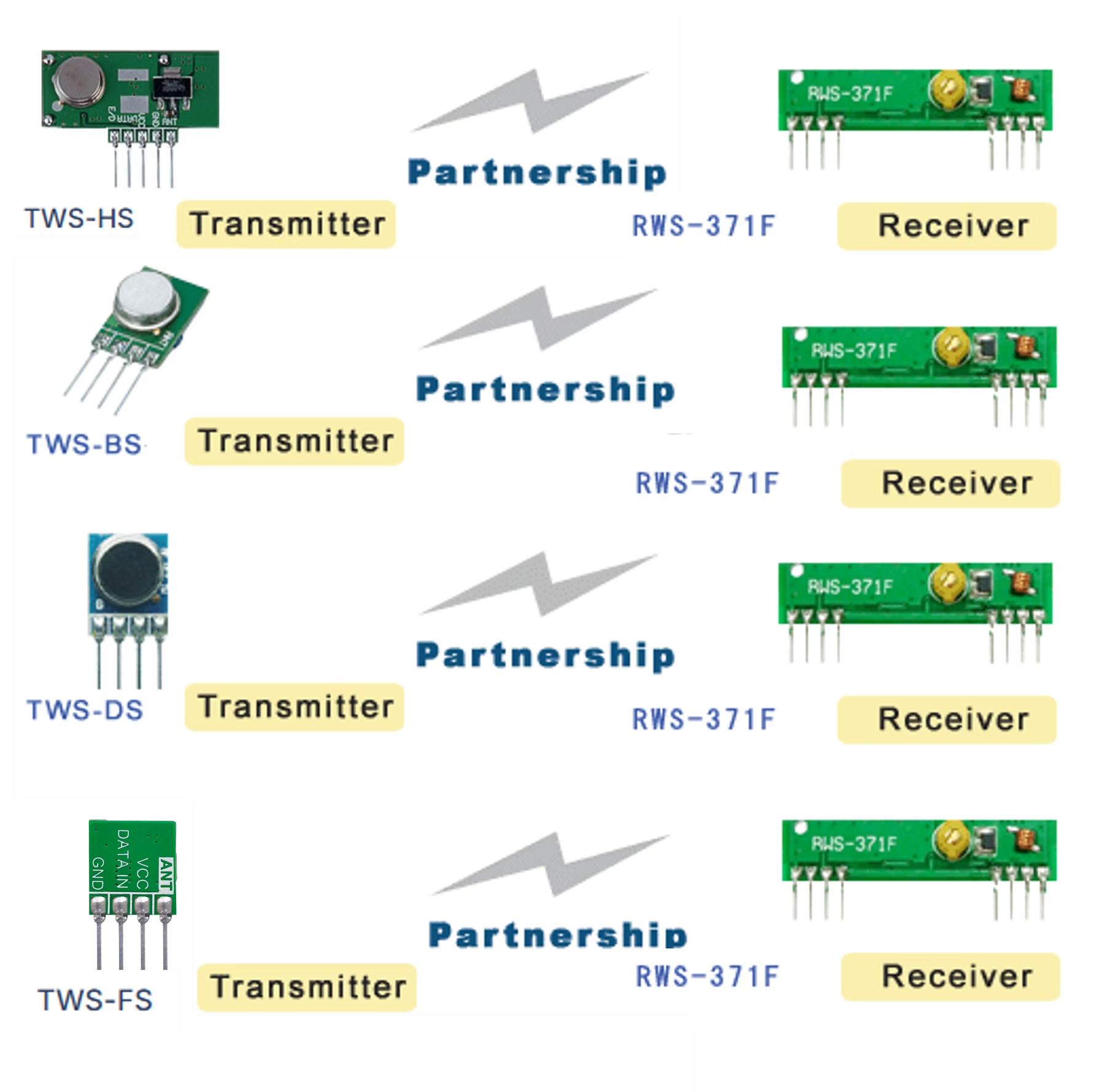
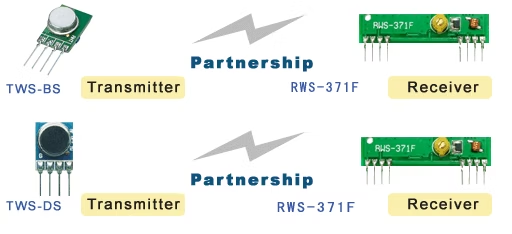
To ensure optimal performance of wireless systems, RWS-371F series receiver modules must be paired with corresponding frequency transmitter modules. We offer a complete product line of transmitter modules (TWS series), covering all commonly used frequency bands, making system integration more convenient. When selecting pairing modules, please ensure that the operating frequencies of the transmitter and receiver modules are completely identical to achieve the best communication quality and transmission distance.
Transmitter Module Model
Operating Frequency
Recommended Receiver Module
TWS-BS、TWS-DS
303.875 MHz
RWS-371F-1
TWS-BS、TWS-DS
310.000 MHz
RWS-371F-2
TWS-HS、TWS-BS、TWS-DS、TWS-FS
315.000 MHz
RWS-371F-3
TWS-BS、TWS-DS
318.000 MHz
RWS-371F-4
TWS-BS、TWS-DS
418.000 MHz
RWS-371F-5
TWS-HS、TWS-BS、TWS-DS、TWS-FS
433.920 MHz
RWS-371F-6
Pin Definition and Wiring Instructions
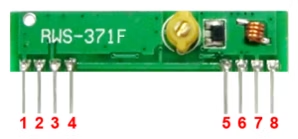
The module features a standard 2.54mm pitch pin design, allowing direct insertion into breadboards or PCB sockets, or permanent fixture onto circuit boards via soldering. It is recommended to install a 100nF decoupling capacitor between VCC and GND to enhance system stability.
Pin
Function
1
GND
2
Digital Output
3
Linear Out
4
VCC
5
VCC
6
GND
7
GND
8
ANT(About 13cm)
Power Input (VCC)
Power input terminal (3.8~5.5V)
Ground (GND)
Ground terminal, connect to system ground
Data Output (DATA)
Data output terminal, outputs demodulated digital signal
Antenna Input (ANT)
Antenna connection point, connect to external antenna or antenna trace
Main Application Areas
In addition to the aforementioned core applications, the RWS-371F series extends into emerging fields such as smart homes, public utility control, and IoT end devices. With the popularization and maturity of wireless communication technology, more and more system designers are choosing wireless solutions to simplify wiring, reduce installation costs, and enhance system flexibility. Below are five other important application directions.
Residential and Commercial Alarm Systems
Integrated into modern smart alarm systems, receiving wireless signals from various sensors, including door/window reed switches, glass break detectors, passive infrared (PIR) sensors, etc. Supports multi-point deployment, where a single receiving host can simultaneously monitor multiple sensors, significantly simplifying system wiring and installation processes.
Remote Water and Electricity Switch Control
Applied in smart home water and electricity equipment control, such as remote on/off control for electric water heaters, electric heaters, air conditioners, or lighting systems. Users can wirelessly control devices via handheld remote controls or wall switches, achieving smart upgrades without rewiring, especially suitable for renovation projects in existing buildings.
Wireless Data Receiving Terminal
As a receiving end for low-rate wireless data transmission systems, applied in environmental monitoring, agricultural sensor networks, or simple telemetry systems. The 4.8Kbps transmission rate is sufficient to meet the data feedback requirements for temperature, humidity, pressure, liquid level, and other sensor data, making it an ideal choice for building low-cost wireless sensor networks.
Low-Power RF Control Equipment
Designed for battery-powered or energy-constrained applications. Typical operating current is only 4.5mA, and the average power consumption can be further reduced in intermittent reception mode. Suitable for wireless sensor nodes, portable remote control devices, or wireless control terminals that require long-term independent operation.
The module supports fast startup and sleep mode switching, allowing the system to dynamically adjust power consumption according to actual needs, achieving the best balance between power saving and response speed.
MCU / PLC Wireless Receiver Module
As a wireless expansion module for microcontrollers (MCU) or programmable logic controllers (PLC) systems, providing RF reception functionality. The DATA output pin can be directly connected to the MCU's GPIO or interrupt input pins, and the software only needs simple logical judgment and decoding to integrate wireless communication functions.
Supports various mainstream development platforms and programming languages, including Arduino, Raspberry Pi, STM32, etc., shortening product development cycles.
6
Frequency Versions
Covering mainstream bands
-108
dBm Sensitivity
Ultra-high reception sensitivity
4.5
mA Operating Current
Low power design
<3
ms Startup Time
Fast response capability

Technical Support and Customization Services
We provide comprehensive technical documentation, application notes, and reference designs to help engineers quickly complete system integration. For special frequency requirements or customized development needs, please contact our technical team, and we will provide professional solution suggestions.