Interconnected Wireless Smoke Detector
A wireless smoke detector designed for modern buildings and smart fire protection systems, utilizing 433MHz wireless communication technology to provide reliable fire warning protection. This system is suitable for various applications such as residential, commercial buildings, and industrial plants, offering significant advantages like rapid response, easy installation, and no wiring required. Through advanced photoelectric sensing technology and intelligent algorithms, it can promptly issue alarms at the early stage of a fire, gaining valuable time for personnel evacuation.
Product Core Technology Advantages
433MHz Wireless Transmission
Adopts stable and reliable 433MHz ISM band, with a transmission distance of up to 100 meters (open environment) and strong wall penetration, ensuring wide signal coverage. Low power consumption design combined with optimized communication protocol allows for a battery life of 3-5 years.
Photoelectric Sensing Technology
Utilizes advanced photoelectric scattering principle, offering high sensitivity to various smoke particles. The intelligent algorithm effectively reduces false alarm rates, capable of distinguishing between smoke and interference sources like steam or dust, ensuring alarm accuracy.
Rapid Response Mechanism
From smoke detection to alarm activation, it only takes 3-10 seconds, ensuring a quick response. The 85-decibel high-volume alarm ensures it can be clearly heard even in noisy environments, providing multiple layers of personnel safety.
The product complies with international fire safety standards and has passed multiple certifications such as CE and FCC. It uses industrial-grade components, with a working temperature range of -10°C to +50°C and humidity range of 10%-95%RH (non-condensing), adapting to various harsh environments. Its modular design facilitates maintenance and replacement, reducing long-term usage costs.
Complete Product Model Series
Model | Frequency Band | Special Features | Application Scenarios | |
WS-SMOKE-9C | 900MHz | Photo Capture Function | High-end applications requiring visual records | |
WS-SMOKE-9L | 900MHz | LED Indicator Light | Commercial buildings, office spaces | |
WS-SMOKE-4R | 433MHz | PIR Human Body Sensor | Residential, apartment smart linkage | |
WS-SMOKE-4L | 433MHz | LED Indicator Light | Standard residential, commercial applications | |
WS-SMOKE-4RH | 433MHz | PIR + Hotel Version | Dedicated for hotels, B&Bs | |
WS-SMOKE-4LH | 433MHz | LED + Hotel Version | Dedicated for hotels, B&Bs |
We offer 6 models of wireless smoke detectors with different configurations, meeting comprehensive needs from residential to commercial, and from standard to special application scenarios. The 900MHz series provides longer transmission distance and stronger anti-interference capability, suitable for large buildings. The 433MHz series offers high cost-effectiveness, suitable for small and medium-sized projects. The hotel version is specially optimized for hotel industry requirements, complying with hotel fire safety regulations.
900MHz High-End Series
Long-distance transmission, photo recording, suitable for large projects
433MHz Standard Series
High cost-effectiveness, comprehensive functions, wide application
Hotel-Specific Series
Complies with industry regulations, professional customization, rapid deployment
Broad Application Scenarios
Residential and Apartments
Provides 24/7 fire monitoring protection for homes, achieving whole-house coverage without complex wiring. Particularly suitable for old building renovation projects, installation is simple and does not damage existing decor. Supports networking of multiple detectors, where an alarm in one area triggers a response throughout the house.
Commercial Office Spaces
Suitable for commercial environments such as office buildings, retail stores, and dining establishments. Can be integrated with building automation systems for centralized monitoring and management. Meets fire safety regulations, ensuring the safety of employees and customers.
Industrial Plants and Warehouses
Provides reliable fire early warning in large open spaces. Strong anti-interference capability, adapting to dust and humidity fluctuations in industrial environments. Can be deployed in high-bay warehouses, production workshops, and other areas where wiring is difficult.
Special Application Scenarios
Applicable to public facilities such as hospitals, schools, and nursing homes. Supports linkage with emergency lighting and smoke exhaust systems. Can be extended to connect to a central fire control room for regional management and rapid response.
Multi-story Interconnected Defense System
When a fire occurs in one area, the system automatically links all detectors on all floors to sound an alarm simultaneously, achieving whole-floor fire early warning coverage. Suitable for high-rise residential buildings, office buildings, hotels, and other multi-story structures.
Technical Specification Parameters
1
Wireless Communication Specifications
- Operating Frequency: 433.92MHz ±75KHz
- Modulation Method: ASK/FSK
- Transmission Distance: 100 meters (open area) / 30-50 meters (indoor)
- Transmitting Power: ≤10mW
- Receiving Sensitivity: -105dBm
2
Detection Performance Indicators
- Sensing Method: Photoelectric scattering principle
- Sensitivity Level: Complies with UL217 standard
- Response Time: 3-10 seconds
- Alarm Volume: ≥85dB (at 3 meters)
- False Alarm Rate: <0.1%
3
Power and Power Consumption
- Power Supply: DC 3V (2×AA batteries)
- Static Current: <15μA
- Alarm Current: <30mA
- Battery Life: 3-5 years (depending on usage frequency)
- Low Voltage Alert: Alerts once per minute when <2.4V
4
Environment and Mechanical
- Operating Temperature: -10°C ~ +50°C
- Operating Humidity: 10% ~ 95% RH (non-condensing)
- Casing Material: Flame-retardant ABS plastic (V-0 grade)
- Dimensions: Φ120mm × 45mm
- Installation Method: Ceiling-mounted screw fixing
Certification Standards | CE, FCC, RoHS, UL217, EN14604 | |
Protection Rating | IP20 (indoor use) | |
Product Weight | Approx. 150g (including batteries) | |
Packaging Specifications | 100 units/carton, Carton size: 62×52×48cm |
System Features
Wireless Networking Capability
Supports up to 32 detectors interconnected, with one alarm triggering a network-wide response. Adopts a two-way communication protocol to monitor the status of each node in real-time. Automatic frequency hopping and anti-interference technology ensure stable and reliable communication, suitable for large building deployments.
Smart Power Management
Utilizes an ultra-low power microprocessor and optimized sleep/wake-up mechanism. Real-time battery level monitoring, automatically sends an alert tone and wireless signal when voltage is low. Supports quick battery replacement without the need for re-pairing or code learning.
Self-Check and Fault Diagnosis
Automatically performs a system self-check every 60 seconds, including sensor, circuit, and battery status. Immediately issues an alert upon detecting a fault, and reminds the user via LED indicator and buzzer. Full functional testing can be manually triggered via the test button.
Multi-Level Alarm Mechanism
Three-stage progressive alarm tone, from gentle reminders to urgent alerts. LED indicator flash frequency changes with the level of danger. Supports linkage with external alarm equipment, and can be integrated into central fire control systems for remote monitoring.
Installation and Deployment Guide
Site Survey and Planning
Evaluate building structure, area, and layout to determine the number of detectors and installation locations. Install at least one detector in each enclosed space. For large open areas, configure one detector every 60-80 square meters. Avoid air conditioning vents and kitchen grease areas.
Installation Location Selection
Detectors should be installed in the center of the ceiling, at least 50cm from walls. For sloped ceilings, install at the highest point. In narrow spaces like corridors, install one every 15 meters. Avoid installation in damp, high-temperature, or strongly airflow-affected locations.
Physical Installation and Fixing
Use expansion screws to secure the base to the ceiling. Ensure the base is level and firm. Connect the battery and rotate the detector body to lock it onto the base. After installation, gently pull to confirm secure fixing. Record the number and location of each detector.
System Pairing and Testing
Perform wireless pairing and learning code for the detector with the receiving host. Press the test button to simulate smoke and trigger an alarm, verifying sound, light, and wireless transmission functions. Check that all detectors can interconnect and respond. Record test results and archive them.
User Training and Handover
Demonstrate system operation, test button usage, and battery replacement methods to users. Explain key points for daily maintenance and periodic inspection cycles. Provide product manuals, warranty cards, and after-sales service contact information. Establish a maintenance file and inspection plan.
Installation Precautions: Please read the product manual carefully before installation. Ensure correct battery polarity. It is recommended to fully test all functions before first use. Regularly clean the detector surface to prevent dust accumulation from affecting sensitivity.
System Integration Solutions
Integration with Smart Home Platforms
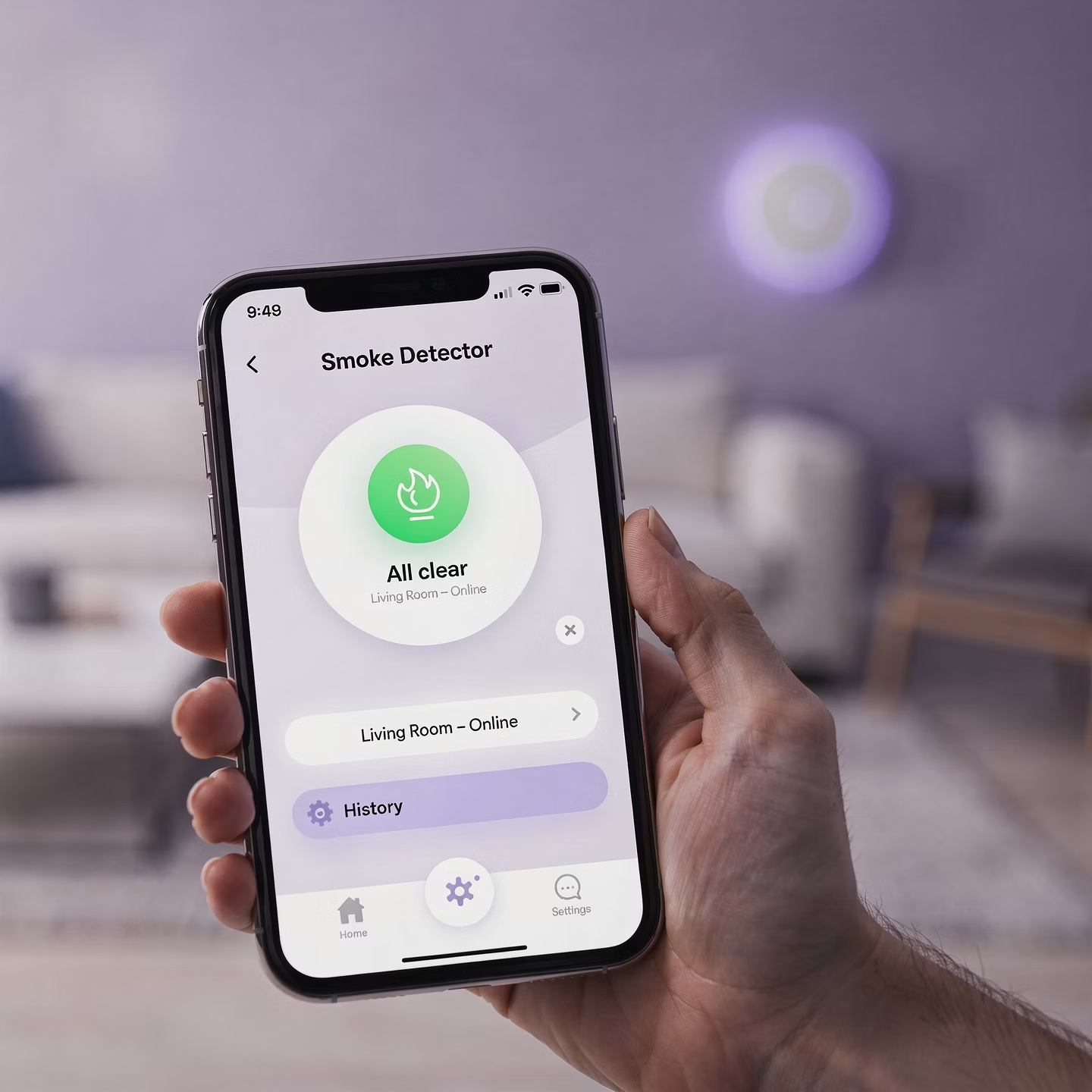
This wireless smoke detector can be connected to mainstream smart home platforms via a gateway device, including open ecosystems like Home Assistant and SmartThings. It enables remote monitoring via mobile APP and real-time push notifications for alarms. It supports联动 with smart lighting, electric curtains, and air conditioning systems, automatically activating emergency lighting, shutting down air conditioning, and opening windows for smoke evacuation during a fire alarm.
Building Automation System Interfacing
Through standard Modbus RTU/TCP or BACnet protocols, detector signals can be integrated into Building Management Systems (BMS). This achieves centralized monitoring, data recording, and report generation. It supports integration with fire linkage controllers, emergency broadcasting systems, and fire door control systems, building a complete fire automation solution.

Wireless Detector
Front-end sensing equipment
Communication Gateway
Protocol conversion hub
Cloud Platform
Data processing center